
Six months after the war began with the killing of Iran’s supreme leader, Washington and Tehran are trading blows again. Here is the conflict in numbers — the timeline, the shipping chokepoint, oil prices, nuclear risk and the human cost.
The 2026 Iran war entered a fresh and dangerous phase on September 1, when U.S. strikes inside Iran — including one that hit a home hosting a wedding in the southern county of Sirik — killed civilians and triggered immediate retaliation. Iran fired on U.S. bases and Gulf neighbors; President Donald Trump called the latest strikes “justified,” warned Tehran against reprisals, and even suggested renaming the strategic Strait of Hormuz the “Trump Strait.” With the conflict in its sixth month and congressional midterms two months away, here is everything you need to know, in numbers.
1. The latest escalation: September 1–2
U.S. Central Command announced it struck Islamic Revolutionary Guard Corps (IRGC) targets near the Strait of Hormuz, citing attacks on U.S. forces and ships in the waterway. Iranian officials and the Red Crescent said one strike hit a home where a wedding was being held in Kuhestak, in Sirik county, killing at least four people — including a child — and wounding dozens; some reports put the toll at five dead and about 50 wounded. Separate attacks were reported near the city of Ahvaz and at the civilian Jiroft airport in southeast Iran.
Iran retaliated quickly, firing on U.S. bases and Gulf neighbors, and accused Washington of a “war crime.” More strikes were exchanged on September 2, fuelling fears of a full return to hostilities. President Trump defended the campaign, telling reporters the strikes were “justified” and warning Tehran not to escalate further, while floating the Strait of Hormuz renaming — an idea that would rename one of the world’s most important waterways.
2. Timeline: six months of war
| Date | Event |
|---|---|
| Feb 28 | Israel and the U.S. attack Iran, killing Supreme Leader Ali Khamenei and other top officials. Iran strikes Israel and the Gulf region and asserts control over the Strait of Hormuz. |
| Mar 2 | Hezbollah enters the war, firing rockets at Israel; Israel launches a ground invasion of southern Lebanon. |
| Mar 8 | Iran names Khamenei’s son Mojtaba as its new supreme leader; he is believed to be in hiding after being hurt in the opening strikes. |
| Apr 7 | A tenuous two-week ceasefire is reached (Israel is not included). |
| Apr 12–13 | Historic face-to-face U.S.–Iran talks in Islamabad end without agreement; Trump announces a blockade of Iranian ports. |
| Apr 21 | Trump says he is “indefinitely extending” the ceasefire. |
| May 31 | Israel’s ground invasion of Lebanon makes its deepest incursion in over 25 years. |
| Jun 7 | Iran fires at Israel in its first bombardment since the ceasefire took effect in April. |
| Jun 17 | Interim deal signed: Iran agrees to dilute its stockpile of highly enriched uranium; the U.S. waives sanctions and Iran may sell oil freely. |
| Jul 7 | Iran is accused of striking three ships in the strait in one day; the U.S. strikes dozens of targets and reinstates oil sanctions. |
| Jul 8 | Trump declares the ceasefire “over.” |
| Jul 12 | U.S. forces hit 140+ targets in Iran after an Iranian strike on a container ship; Iran says the strait is “closed until calm is restored.” |
| Aug 20 | Trump announces “economic D-Day” against Iran. |
| Aug 24 | Treasury Secretary Scott Bessent details the plan: secondary sanctions plus roughly 60 sanctioned firms, individuals and shadow-fleet vessels. |
| Aug 26 | Iran and Oman announce a temporary shipping corridor and revenue-sharing deal for the strait. |
| Aug 30 | U.S. strikes Iranian minelaying positions on Larak Island — the first U.S. attack since the campaign was paused in late July. |
| Sep 1 | U.S. strikes IRGC targets near Hormuz; a strike hits a wedding in Sirik; Iran retaliates; Trump calls the strikes “justified.” |
3. The Strait of Hormuz by the numbers
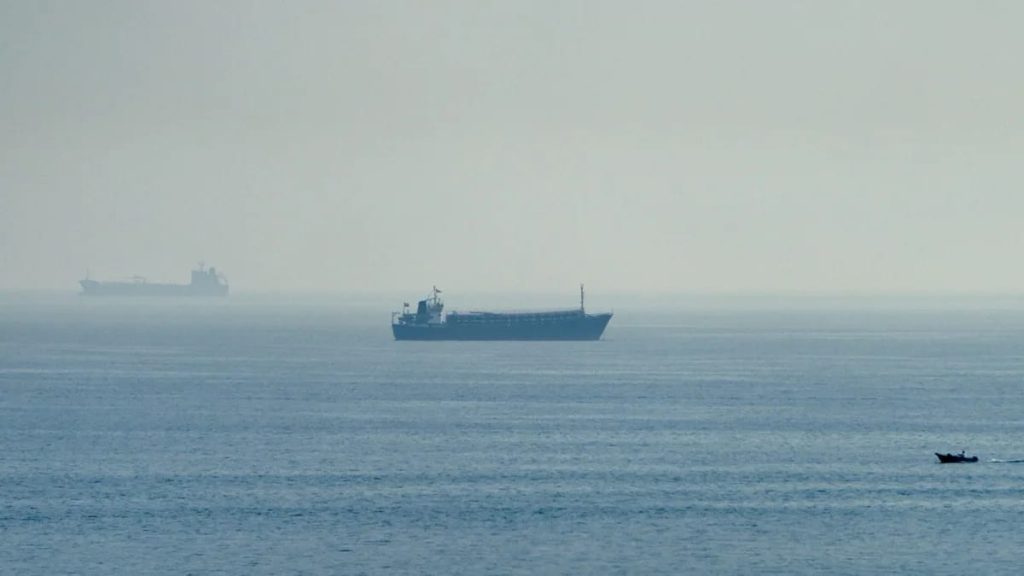
The strait — a narrow waterway between Iran and Oman — is the world’s most important energy choke point. In 2024, about 20 million barrels per day (mb/d) of oil flowed through it, roughly 20% of global petroleum-liquids consumption, according to the U.S. Energy Information Administration. The IEA puts it even higher by crude: in 2025, nearly 15 mb/d of crude oil — about 34% of global crude trade — passed through, with China and India receiving 44% of those exports.
The war has cut that flow dramatically. Maritime analytics firm Kpler confirmed in late August that oil flowing through the strait had fallen to an average of about 8.6 mb/d — under half of normal conditions. Iran asserts sole control of the waterway, has warned that tankers must use IRGC-approved routes “or face a forceful response” (July 2), and reportedly began collecting tolls in Chinese yuan on oil sold through the strait. On August 26, Iran and Oman agreed on a temporary shipping corridor with revenue sharing — while Tehran’s deputy foreign minister cautioned the strait “would not reopen to U.S. vessels” until Washington fulfills obligations from the June memorandum of understanding.
Mining is a live threat: the U.S. struck Iranian minelaying launchers on Larak Island near Bandar Abbas on August 30, and Qatar’s prime minister traveled to Tehran two days earlier to discuss clearing mines from the waterway.
4. Oil and the energy shock
| Date | Brent crude price / move |
|---|---|
| Before the war | Roughly $70 per barrel |
| Early March 2026 | Surging 10–13% to about $80–82/bbl within days of the Feb 28 strikes |
| July 26 | Falling 8.7% to $88.36/bbl as U.S. and Iran paused fighting for a second time |
| Aug 18 | Rising above $90/bbl — first time since July 30 — after Trump told Tehran to “surrender” |
| 3Q 2026 (forecast) | EIA expects Brent to average about $85/bbl; BloombergNEF warns of $91/bbl if disruption persists |
The combination of a partially closed strait and renewed sanctions has produced what analysts describe as a global fuel crisis and severe economic disruption, hitting Asian consumer economies — China and India above all — hardest.
5. The nuclear dimension
Iran entered the war with a large stockpile of uranium enriched to near-weapons grade (60%), most of it stored, per the IAEA, in an underground tunnel complex at Isfahan. Under the June 17 interim deal, Tehran committed to diluting that highly enriched stockpile in exchange for sanctions relief and free oil sales — but the deal is fraying: the IAEA said in June it remains unable to verify the suspension of Iran’s enrichment, reprocessing and heavy-water programs, and the IAEA Board on June 10 passed a resolution demanding Iran declare its remaining enriched-uranium stocks. If the deal collapses, Iran’s path to weapons-grade material would be measured in months rather than years — the central strategic fear that started this war.
6. The human cost
| Measure | Estimate | Basis |
|---|---|---|
| Total deaths, all sides | 8,000–10,600 | Compiled totals (Wikipedia casualty page) |
| Wounded, all sides | 48,775–54,805 | Compiled totals (Wikipedia casualty page) |
| Killed in Iran / Lebanon / Gulf states | 3,468 / 3,696 / 28 | Al Jazeera tracker figures as of June 10 |
| Iranian civilians killed | More than 1,200 by mid-March | NPR, citing official figures at the time |
| U.S. military | 624 wounded (Pentagon, late July); tracker estimates 18 dead | NYT / Pentagon; iranwarlive.com |
| Seafarers killed in Hormuz attacks | 19 | Iran-war tracker estimate (Sep 2026) |
| Sirik wedding strike (Sep 1) | 4–5 dead incl. a child; 20–50 wounded | Iranian officials, Red Crescent; Daily Sabah, Middle East Eye, Boston Herald |
Beyond Iran, the war’s casualty center is Lebanon, where Israel’s campaign against Hezbollah has occupied large areas of the south since March, and where several thousand people have been killed.
7. “Economic D-Day”: the sanctions assault
On August 24, Treasury Secretary Scott Bessent unveiled the “economic D-Day” strategy first announced by Trump on August 20: secondary sanctions on foreign countries doing business with Iran, expanded authority covering digital assets, technology, gold, aviation and shipping, and sanctions against nearly 60 corporations, individuals and shadow-fleet vessels. Bessent said Trump would personally call foreign leaders to demand they stop trading with Tehran; Iran promised to retaliate in a “seismic manner.”
History shows how punishing these measures can be: during Trump’s first term, “maximum pressure” sanctions of 2018–19 cut Iran’s oil exports by more than half, and the sanctions of 2011–15 shrank Iran’s economy by about 20% with unemployment at 20%. Trump has also threatened to strike Iran’s civilian infrastructure and suggested the U.S. could seize Kharg Island, the key hub for Iran’s oil exports.
8. What happens next — and why it matters
- Asia first in the firing line: with China and India taking 44% of Hormuz crude flows, any full closure hits the world’s two biggest importers hardest — and global inflation with them.
- The U.S. midterms: with elections on November 3, Trump faces the war’s political whiplash — high fuel prices and war-weariness at home, while aides already fear a Republican “midterm rout.”
- Mediation channels: Qatar, Pakistan and Oman are all trying to revive talks; Iran insists the strait reopens to U.S. vessels only if the June memorandum’s obligations are met.
- Israel–Lebanon front: fighting there remains violent, with new U.S.-backed frameworks so far failing to hold.
- Nuclear watch: every day of collapsed diplomacy leaves Iran’s enriched stockpile less inspected and closer to weapons capability — the very outcome the war set out to prevent.
Six months in, the 2026 Iran war has already reshaped global energy markets, produced one of the century’s most consequential assassinations, and killed thousands. The next weeks — whether Tehran’s retaliation widens, whether oil tests $91, and whether Trump’s “economic D-Day” bites — will determine whether this becomes a new regional order or a broader catastrophe.
Sources and further reading
- AP — Timeline of the Iran conflict and talks aimed at ending it
- AP — Iran fires on Gulf neighbors, retaliating for U.S. strikes after a wedding was hit
- CFR Global Conflict Tracker — U.S.–Iran confrontation
- Wikipedia — 2026 Iran war · Casualties of the war
- Wikipedia — Economic impact of the war (oil price data)
- IEA — Strait of Hormuz: 15 mb/d crude, 34% of global crude trade (2025)
- U.S. EIA — Strait of Hormuz oil flows (2024–25)
- NY Post / Kpler — Hormuz flows now average 8.6 mb/d
- The Guardian — Brent above $90 as Trump tells Tehran to surrender
- NYT — Oil prices sink as fighting pauses (Brent −8.7% to $88.36)
- EIA Short-Term Energy Outlook — Brent to average ~$85 in 3Q26
- BloombergNEF — $91/bbl risk on prolonged disruption
- Reuters — IAEA board demands Iran declare enriched-uranium stocks
- ISIS — Analysis of IAEA Iran reports, June 2026
- Al Jazeera — IAEA: Iran stored most highly enriched uranium at Isfahan
- NPR — Casualties of the war (as of March 13)
- Al Jazeera — Death toll and injuries live tracker
- NYT — Pentagon changes how it reports Iran-war casualties
- Daily Sabah — 4 killed after U.S. strike hits wedding in southern Iran
- NYT — Bessent’s Treasury assault on the Iranian economy
- NPR — Iran vows “seismic” response to new sanctions