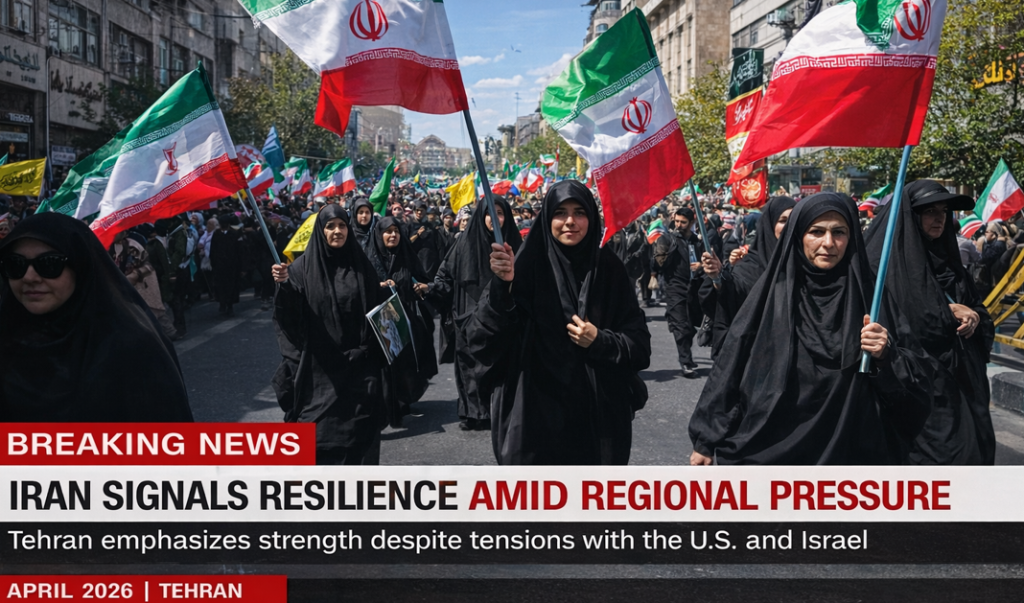

Tehran, April 2026 — As Iran faces rising regional conflicts and domestic difficulties, officials are portraying a narrative of resilience, underscoring their strength despite the ongoing pressures from the United States and Israel.
Recent large public gatherings in Tehran and other urban areas have captured attention, with participants waving national flags and showing support for the nation’s leadership. Messaging from the state has presented these events as symbols of unity and defiance, bolstering the idea that Iran continues to withstand both external and internal challenges.
“Iran has encountered major obstacles, yet is coming through stronger amidst tensions,” is a commonly voiced perspective in official statements, demonstrating the government’s effort to project a sense of stability and authority. Nevertheless, this portrayal is not wholly accepted, and the overall situation is intricate.
Internal Strains and Public Sentiment
Even with the outward appearance of strength, Iran still grapples with significant internal problems. Economic difficulties, fueled by sanctions, rising prices, and unemployment, have led to growing public discontent. In recent years, various protests have surfaced regarding economic issues, social liberties, and government practices.
While some protests seem to support the administration, others express criticism, underscoring a split in public opinion. Analysts suggest that the promotion of pro-government demonstrations is a tactical effort to mitigate negative international portrayals and quell internal dissent.
“The administration is attempting to shape the narrative,” observed one regional expert. “Yet the truth on the ground is more complex. There exists both support and considerable frustration.”
Regional Tensions Remain High
The relationship between Iran, the United States, and Israel continues to be a significant source of geopolitical friction. Disagreements concerning Iran’s nuclear ambitions, regional dominance, and military activities have heightened tensions in the area.
Both Washington and Tel Aviv have maintained a hardline approach towards Iran’s strategic goals, while Iran has countered with its own discourse of resistance and deterrence. This ongoing standoff has led to a cycle of escalating tensions, with no clear end in sight.
However, labeling the situation as a “victory” for either party would be erroneous. Experts highlight that the conflict remains unfinished, with each side confronting its strategic and political limitations.
Narrative vs Reality
The assertion that Iran is “coming out on top” is primarily a political narrative rather than an established truth. Governments frequently employ such messaging to boost morale and claim legitimacy, especially in times of turmoil.
In practice, Iran is engaged in a delicate balancing act—seeking to retain internal stability while dealing with external pressures. Its capacity to maintain this stance hinges on various factors, such as economic recovery, diplomatic activity, and public opinion.
“There isn’t a clear victor here,” remarked another analyst. “What we are witnessing is an extended conflict where each side strives to assert dominance.”
Looking Ahead
As tensions continue, Iran’s leadership will likely keep reinforcing themes of resilience and defiance. Whether this narrative will lead to long-term stability is still unclear.
The upcoming months will be pivotal in shaping how the situation unfolds, especially concerning economic conditions and regional diplomatic efforts. For the time being, Iran’s stance is explicit: it aims to project strength, even while facing considerable challenges beneath the surface.