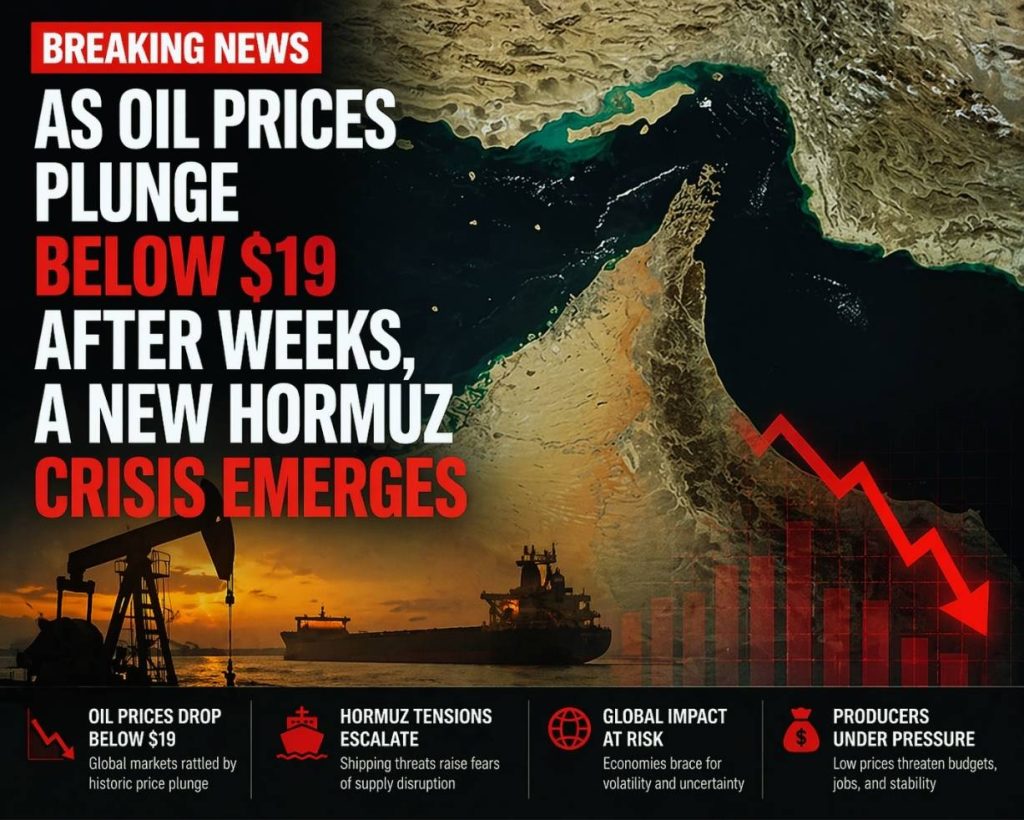

The global oil market has once again been thrown into turmoil as crude prices plunge below $19 per barrel, marking one of the steepest and most prolonged declines in recent history. What initially appeared to be a demand-driven collapse has now evolved into a far more complex crisis, exacerbated by renewed geopolitical tensions in the Strait of Hormuz — one of the world’s most critical oil transit chokepoints. The convergence of collapsing prices and rising instability is not just a coincidence; it is a dangerous feedback loop that could reshape energy markets, global trade, and geopolitical alliances.
The price crash did not happen overnight. Over the past several weeks, oil markets have been under sustained pressure due to weakening global demand. Economic slowdowns across major economies, particularly in Asia and Europe, have reduced industrial output and transportation needs. At the same time, oil-producing nations have failed to coordinate effective production cuts. Instead of tightening supply, some producers have ramped up output in a bid to maintain market share, flooding an already oversupplied market.
But here’s the hard truth: low prices alone don’t create stability — they often signal deeper dysfunction. When oil drops below $20, it’s not just cheap fuel; it’s a warning that something is fundamentally broken in the balance between supply, demand, and geopolitical control.
Enter the Strait of Hormuz.
This narrow waterway, connecting the Persian Gulf to the Arabian Sea, handles roughly a fifth of the world’s oil shipments. Any disruption here is not a regional issue — it’s global. And now, tensions are escalating once again. Reports of tanker seizures, military posturing, and threats of blockades have reignited fears that the flow of oil could be interrupted at any moment.
Here’s where the situation gets counterintuitive: you’d expect geopolitical tension in such a critical region to push oil prices up. Historically, that’s exactly what happens. But this time, prices remain depressed despite rising risks. Why?
Because the market doesn’t believe the threat — yet.
Traders are essentially betting that the geopolitical tensions will not escalate into a full-scale disruption. They’ve seen similar flare-ups before that ended in rhetoric rather than real supply shocks. So instead of reacting to potential risk, markets are anchored to present realities: oversupply and weak demand.
That’s a dangerous miscalculation.
If the situation in Hormuz escalates beyond posturing — say, through an actual blockade or sustained attacks on shipping — the market could snap violently in the opposite direction. Prices wouldn’t just recover; they could spike dramatically in a very short period. This kind of whiplash would be far more damaging than steady high prices, as it introduces extreme volatility into an already fragile global economy.
Meanwhile, oil-producing countries are bleeding.
At sub-$20 prices, most producers are operating below their breakeven costs. Countries heavily dependent on oil revenues — from the Middle East to parts of Africa and Latin America — are facing severe fiscal strain. Budget deficits are widening, currency values are under pressure, and social stability is becoming a real concern.
Let’s be blunt: prolonged low oil prices don’t just hurt economies — they destabilize governments.
And instability in oil-producing regions doesn’t stay local. It spreads through migration, conflict, and disruptions in global supply chains.
On the corporate side, the damage is equally severe. Oil companies, especially smaller shale producers, are being pushed to the brink of bankruptcy. Capital expenditure is being slashed, projects are being halted, and layoffs are mounting. This will have long-term consequences. When investment dries up, future supply gets constrained. So while the market is oversupplied today, it may face a shortage tomorrow.
This sets the stage for a classic boom-bust cycle — but with higher stakes.
Now layer the Hormuz crisis on top of this.
If tensions escalate while investment remains suppressed, the world could face a sudden supply shock with no buffer capacity. Strategic reserves can only cover so much, and ramping up production isn’t instant. The result? A potential energy crisis that hits when the global economy is least prepared to handle it.
There’s also a strategic dimension that’s being overlooked.
Major powers are closely watching the situation. The United States, while less dependent on Middle Eastern oil than in the past, still has strong incentives to maintain stability in the region. China, on the other hand, relies heavily on oil imports passing through Hormuz. Any disruption directly threatens its energy security.
This creates a high-stakes geopolitical chess game.
Military presence in the region is increasing, alliances are being tested, and the risk of miscalculation is rising. All it takes is one incident — one misinterpreted move — to trigger a broader conflict.
And here’s the uncomfortable reality: markets are terrible at pricing in low-probability, high-impact events.
Right now, oil prices suggest complacency. But complacency in a situation like this is exactly what leads to shocks.
So what happens next?
There are three realistic scenarios.
First, tensions in Hormuz de-escalate, and oil prices remain low due to continued oversupply and weak demand. This is the “status quo” scenario — painful but manageable.
Second, a limited disruption occurs — perhaps temporary shipping interruptions or localized conflict. Prices spike moderately, but the situation stabilizes before spiraling out of control.
Third — and this is the one markets are underestimating — a major escalation leads to a sustained disruption in oil flows. In this case, prices could surge dramatically, potentially doubling or tripling within weeks.
If you’re assuming the first scenario is the most likely simply because it’s the least disruptive, you’re making a classic mistake. Probability doesn’t care about convenience.
The oil market today is not just driven by supply and demand — it’s being shaped by uncertainty, geopolitics, and structural imbalances. The plunge below $19 is not a sign of stability; it’s a symptom of deeper fragility.
And the emerging Hormuz crisis is the spark that could expose just how fragile the system really is.
If there’s one takeaway, it’s this: don’t mistake low prices for low risk.
Because right now, the risk is anything but low.